

Discover the 5 stages of trauma healing. Break free from survival mode, release stored trauma, and achieve post-traumatic growth today.
Understanding Your Path Through Trauma Recovery
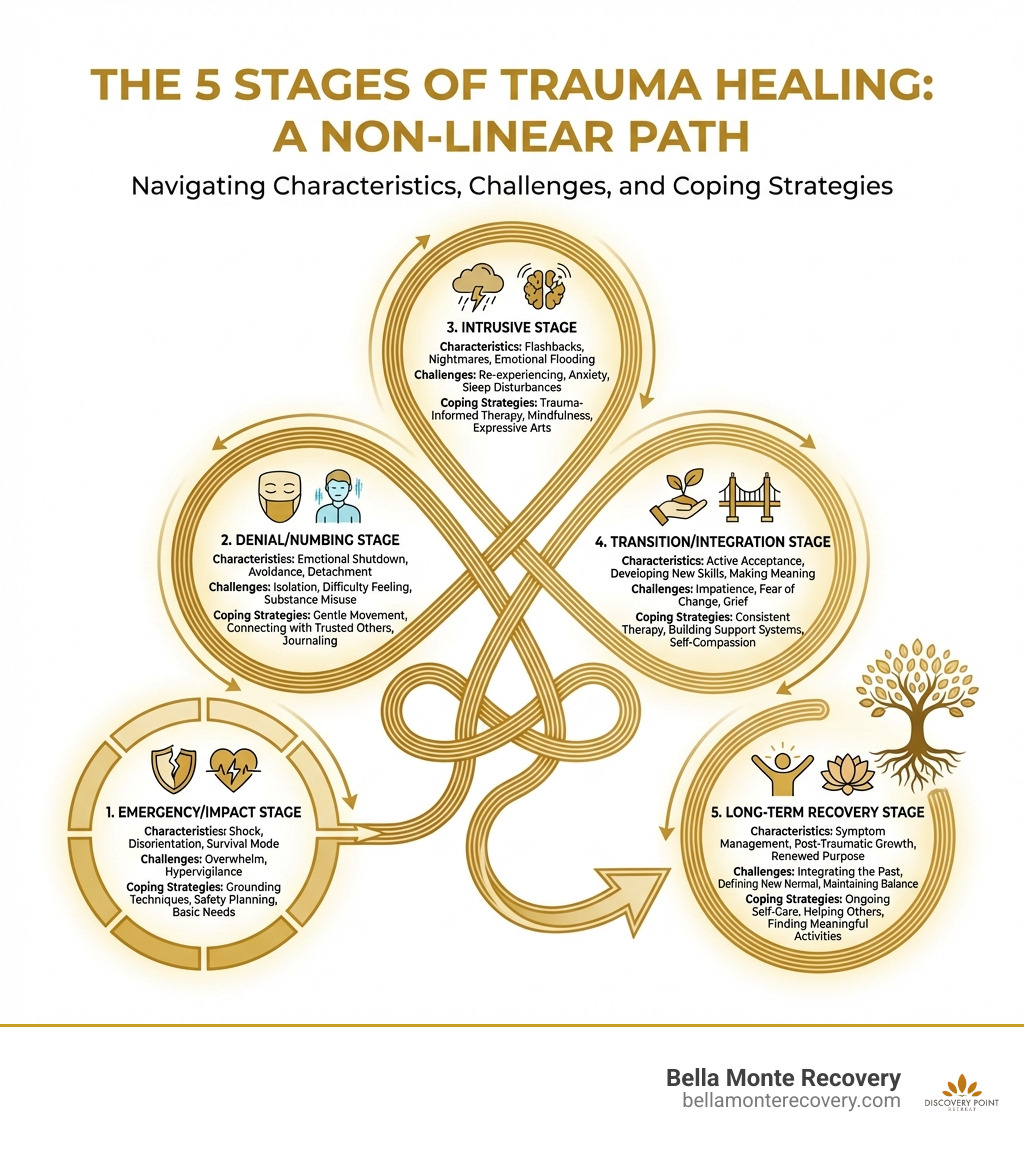
The 5 stages of trauma healing provide a roadmap for understanding how people move from the immediate shock of a traumatic event toward lasting recovery and growth. Here's what the journey typically looks like:
- Emergency/Impact Stage — Immediate survival mode, shock, and disorientation
- Denial/Numbing Stage — Emotional shutdown and avoidance as self-protection
- Intrusive Stage — Flashbacks, nightmares, and overwhelming emotional pain surface
- Transition/Integration Stage — Active acceptance begins, therapy starts, new coping skills develop
- Long-Term Recovery Stage — Consistent symptom management and post-traumatic growth
Recovering from a traumatic event often feels like navigating a maze without a map. You might feel stuck, overwhelmed, or unsure if you're making any progress at all.
Here's what matters: 70% of U.S. adults will experience a traumatic event at least once in their lives. You're not alone in this struggle.
The stages of trauma healing aren't a straight line. You might move forward, then slide back. You might spend months in one stage and weeks in another. Some days you'll feel like you're healing, and other days the pain feels as fresh as it did on day one.
But understanding these stages changes everything. When you know where you are in the journey, you can stop wondering "What's wrong with me?" and start asking "What do I need right now?"
Trauma doesn't just live in your mind—it gets trapped in your body. Your nervous system stays on high alert. Your muscles hold tension. Research shows that people with PTSD report significantly higher rates of chronic pain, digestive issues, and persistent fatigue compared to those without trauma histories.
This guide will walk you through each stage of trauma healing, explain what's happening in your brain and body, and give you practical strategies to move forward. Whether you're just beginning to acknowledge your trauma or you're years into your recovery, understanding this roadmap can help you find your way to emotional freedom.
The Science of Survival: Why Trauma Gets Trapped in the Body
To understand the 5 stages of trauma healing, we first have to understand why we feel "stuck" in the first place. It isn't a lack of willpower; it’s biology.
When we experience a traumatic event—whether it’s a single accident or years of complex emotional abuse—our brain’s "alarm system" takes over.
The Amygdala vs. The Prefrontal Cortex
During trauma, the amygdala (the brain's emotional smoke detector) becomes hyper-reactive. It sends out a frantic "fight-or-flight" signal to the rest of the body. Meanwhile, the prefrontal cortex—the part of the brain responsible for logic, language, and time-stamping memories—effectively goes offline.
Because the prefrontal cortex isn't working correctly, the brain fails to file the memory as "past history." Instead, the trauma stays "live." This is why scientific research on the neurobiology of emotional trauma suggests that trauma causes lasting changes in how the brain handles stress.
The Body Keeps the Score
Trauma isn't just a mental event; it’s a physical one. When the nervous system gets stuck in a state of high arousal, it manifests as physical symptoms. Research from the American Psychological Association on chronic stress shows that emotional trauma contributes to high blood pressure, heart disease, autoimmune disorders, and chronic pain.
Your body remembers what your mind may be trying to forget. This "body memory" is why you might feel a sudden surge of panic or physical pain without knowing why—your nervous system has spotted a "trigger" that reminds it of the original trauma.
Navigating the 5 Stages of Trauma Healing
Healing is rarely a straight line. Think of it more like a winding mountain path. You might feel like you’ve reached a peak, only to find yourself back in a valley the next day. This is normal.
The 5 stages of trauma healing are often compared to the Kübler-Ross grief model (Denial, Anger, Bargaining, Depression, Acceptance). While they share similarities—because trauma always involves the loss of safety or innocence—trauma recovery has its own unique hurdles. Studies published in the Journal of Traumatic Stress on trauma and chronic pain emphasize that healing requires addressing both the mind and the physical body simultaneously.
To help navigate this, many experts point to the "5 R’s of Trauma":
- Relational: Healing happens in the context of safe relationships.
- Relevant: The treatment must fit your specific experience.
- Rhythmic: Repetitive patterns (like breathing or walking) soothe the brain.
- Repetitive: You have to practice new coping skills over and over.
- Rewarding: You need to experience positive moments to rebuild hope.
Stage 1 and 2: From Emergency Impact to Denial in the 5 Stages of Trauma Healing
The first two stages are all about survival.
Stage 1: The Emergency/Impact Stage
This is the immediate aftermath. You are in shock. Your brain is flooded with cortisol and adrenaline. You might feel disoriented, shaky, or completely "out of it." In this stage, the goal isn't "healing"—it's simply finding safety. If you are in Southern California and experiencing this, your priority is securing a safe environment and meeting basic needs like sleep and hydration.
Stage 2: The Denial/Numbing Stage
Once the immediate shock wears off, your brain may try to protect you by numbing your emotions. This is a form of cognitive dissonance. You might tell yourself, "It wasn't that bad," or "Other people have it worse."
While denial serves as a temporary shield, staying here too long prevents the processing of the event. Common behaviors in this stage include:
- Avoiding people or places that remind you of the event.
- Using substances (like alcohol or drugs) to keep the "volume" of your emotions turned down.
- Throwing yourself into work to avoid sitting with your thoughts.
Stage 3: Facing the Intrusive Stage of Trauma Healing
As the "numbness" wears off, the trauma often begins to intrude on your daily life. This is frequently the most difficult part of the 5 stages of trauma healing.
In the Intrusive Stage, the memories that were suppressed start to leak out. You might experience flashbacks, where it feels like the event is happening all over again. Nightmares, hypervigilance (constantly scanning for danger), and sudden panic attacks are common.
This is the stage where many people feel "broken," but it is actually a sign that your brain is trying to process what happened. The challenge is moving from dysfunctional coping to healthy regulation.
| Dysfunctional Coping | Healthy Coping Mechanisms |
|---|---|
| Substance abuse to "black out" memories | Grounding techniques (5-4-3-2-1) |
| Total isolation from loved ones | Reaching out to a trusted support system |
| Self-blame and "bargaining" | Self-compassion and trauma education |
| Suppressing anger until it explodes | Expressing anger through exercise or art |
Breaking the silence is a key part of this stage. Whether it’s telling a therapist or a close friend, bringing the trauma into the light reduces its power.
Stage 4 and 5: Transition, Integration, and Long-Term Recovery
These stages represent the shift from "surviving" to "thriving."
Stage 4: The Transition/Integration Stage
In this stage, you stop fighting the reality of what happened. You move into active acceptance. You might start a professional recovery program or begin specialized therapies like EMDR. You start to reconstruct your personal narrative—moving from "victim" to "survivor."
Stage 5: Long-Term Recovery and Reconstruction
This isn't about the total absence of symptoms; it's about management and growth. You have a "toolbox" of coping skills. You can think about the past without your heart racing. Research on CBT and EMDR effectiveness for PTSD shows that these evidence-based treatments significantly reduce symptoms, allowing for a "new normal."
In this final stage, many people experience post-traumatic growth, where they find new meaning and strength they didn't know they had.
Evidence-Based Strategies to Release Stored Trauma
Because trauma lives in the body, talk therapy is often not enough on its own. We need to "speak" to the nervous system.
- Somatic Experiencing: This focuses on physical sensations in the body to release "trapped" energy.
- EMDR (Eye Movement Desensitization and Reprocessing): This uses rhythmic eye movements to help the brain re-file traumatic memories as "past history."
- Trauma-Focused CBT: This helps you identify and change the negative thought patterns (like "It was my fault") that keep you stuck.
- Grounding Techniques: The 5-4-3-2-1 method is a lifesaver during a flashback. Name 5 things you see, 4 you can touch, 3 you hear, 2 you can smell, and 1 you can taste.
- Physical Movement: Yoga, deep breathing, and even dancing can help reset an overactive nervous system.
Beyond Survival: Achieving Post-Traumatic Growth
There is a concept in psychology called the Judith Herman model, which emphasizes that the final stage of recovery is "Reconnection."
Post-traumatic growth is the highest stage of the recovery roadmap. It doesn't mean you're glad the trauma happened—it means you have integrated the experience into your life in a way that produces:
- Greater personal strength: Knowing you can survive the unthinkable.
- Deeper relationships: Valuing the people who stood by you.
- New possibilities: Shifting your life's direction toward something more meaningful.
- Spiritual growth: A deeper appreciation for life and its mysteries.
Frequently Asked Questions about Trauma Recovery
How long do the 5 stages of trauma healing typically last?
There is no "standard" timeline. For some, the journey takes months; for others, it takes years. Factors like the duration of the trauma, your support system, and whether you seek professional help all influence the timeline. The goal is progress, not speed.
Can you move backward through the stages of healing?
Absolutely. Healing is non-linear. A new stressor or a "trauma anniversary" might pull you back from Stage 5 to Stage 3. This isn't a failure; it's a normal part of the process. Each time you revisit a stage, you do so with more tools and wisdom than before.
What is the difference between grief and trauma stages?
Grief is the response to loss; trauma is the response to a threat to your safety or life. While they overlap (especially in the Denial and Depression phases), trauma recovery requires specific focus on the nervous system and the "fight-or-flight" response, which grief models don't always address.
Conclusion
If you feel stuck in the intrusive or numbing stages of your journey, please know that professional support can make the difference between "treading water" and actually moving forward.
At Bella Monte Recovery, we specialize in helping individuals navigate the 5 stages of trauma healing through a personalized, holistic approach. Whether you are dealing with a single-event trauma or complex, long-term issues, our team in Desert Hot Springs is here to help you reclaim your life.
We provide comprehensive care, including more info about dual diagnosis services for those who have turned to substances to cope with their pain. You don't have to walk this path alone. Sustainable recovery is possible, and your journey toward emotional freedom can start today.